
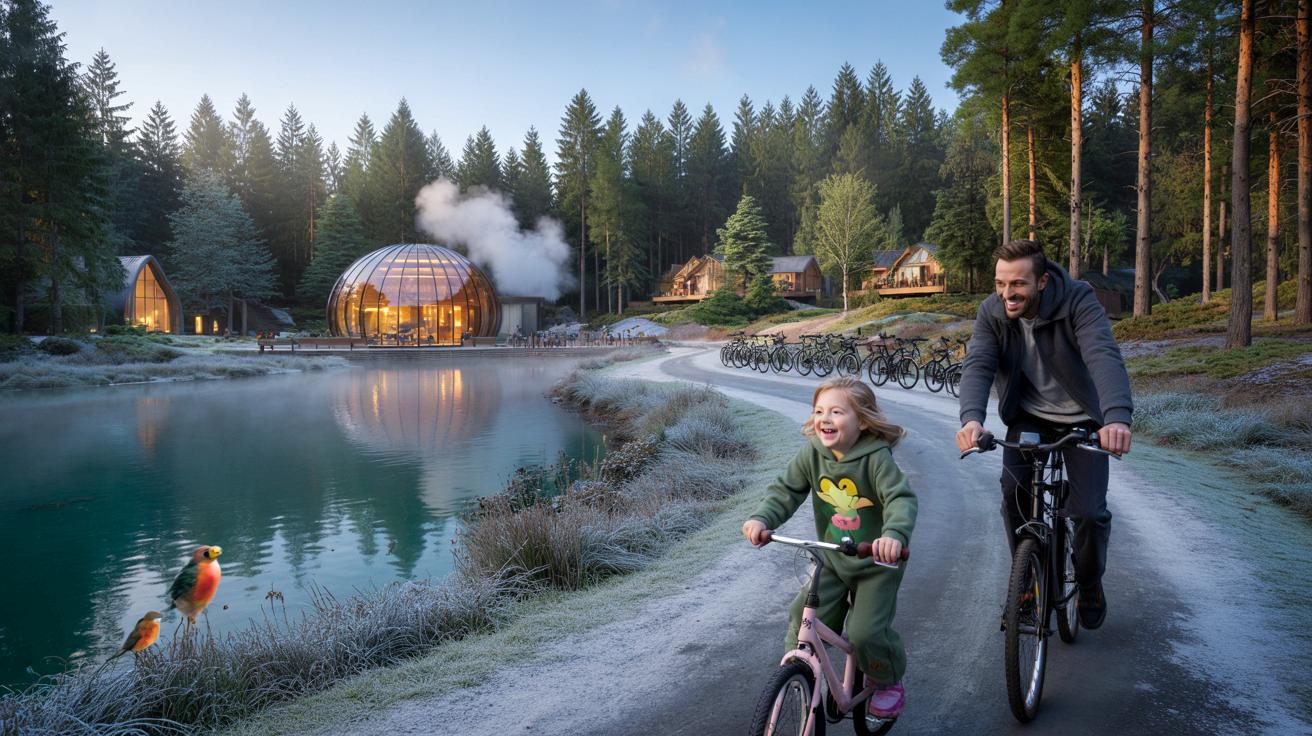
The operator has been scouting quietly, weighing woodlands, traffic models and local feelings. A fresh resort now looks close enough to taste — promising jobs, rows over nature, and thousands of family bikes rolling under pine canopies once again.
The frost lifts in thin sheets off the cycle paths at first light. A little girl in a dinosaur onesie pedals past the lake, her dad wobbling behind, both laughing like they’ve found a secret. Steam curls above the Subtropical Swimming Paradise as swimmers surface and gulp winter air, cheeks bright, towels clutched tight.
Staff swap nods, the café hisses, and out by the tennis courts a pair of robins hop between benches. You hear it in snatches at the coffee queue and whispered by the lifeguards — the UK is poised to get its first new Center Parcs resort in 10 years. A new forest is calling.
Why a new village feels inevitable
Demand has outgrown the map. Every school holiday turns into a calendar of sold-out weekends and polite waiting lists, and midweeks go faster than they used to. Families want the ease — park the car, ditch the screens, find the pool — and the model still works across weather, seasons, moods.
Woburn Forest opened in 2014 and became the last UK addition. Since then, domestic breaks surged, then reset, and still stayed high. The pipeline never matched the appetite. That gap is the story.
Look at the signals. Occupancy has stayed high across UK villages, regularly north of 90% in peak periods, with prices that hold their nerve. Four-bed lodges vanish first, then the treehouses. Search interest spikes at half-term and Christmas, and the off-peak bargains are fewer than they were.
Families have learned the rhythm: book early, split costs, share childcare with grandparents. The restaurants fill because they sit right where energy dips. The spa slots go because the sauna feels like stolen time. All of this points one way — room to grow.
There’s a business logic too. A typical new village costs hundreds of millions to build and can support thousands of jobs across construction and operations. The brand gains scale, negotiating power and a fresh marketing hook. It’s not just more beds in a forest; it’s an engine that spins all year round.
Investors like predictable weekends. Local leaders like payrolls that land in February as well as July. Environmental groups demand better than promises, and planning committees test every claim. The next site will be decided in that triangle of need, money and memory.
What we know — and how to be first through the gates
Watch the breadcrumbs. Site selection often lands on mixed conifer and broadleaf woodland with strong road links and a nearby town for staffing. Early clues include ecology surveys, transport assessments, and quiet conversations with councils. A modern village typically covers 300–400 acres, with 900–1,800 lodges and apartments, a big dome over warm water, and a spa that people book before they admit they need it.
When a proposal is close, you’ll hear about community drop-ins and see diagrams of cycle routes and attenuation ponds. Numbers will be everywhere — parking spaces reduced, biodiversity net gain promised, shuttle buses pencilled in. The operator will talk about protecting habitats and replanting at scale. Residents will talk about owls, hedgerows and headlights.
If you want to be among the first, build your routine now. Sign up for alerts from the company and the likely local authority. Keep an eye on trademark filings and recruitment pages — where training roles appear, shovels follow.
Let’s be honest: nobody really does that every day. Still, a single morning a month can put you months ahead.
“First-year availability goes in a rush,” says a hospitality analyst I spoke to. “Founding guests become repeat guests. The first images do half the selling.”
- Create a shortlist of preferred lodge types and dates now.
- Set price alerts with a weekly snapshot to spot dips.
- Favour midweek arrivals; they’re more flexible and often better value.
- Pair spa slots with early dining; popular hours vanish first.
- Keep a backup date one month later to salvage the plan.
The pitfalls, the promise, and the bits we don’t talk about
Bookings are emotional. People picture birthdays, reunions, first swims without armbands. That’s why prices feel personal when they rise, and why a sold-out Saturday can sting. Pace yourself: decide your red lines in advance — budget range, maximum driving time, and must-have activities — then stick to them when the hype hits.
There’s a sustainability knot to untie. A resort in a forest promises conservation, yet construction is heavy and traffic is real. Local campaigners will test biodiversity plans and night-time light levels; planners will ask about species corridors and water use. This scrutiny is not a nuisance; it’s the only reason the promise holds.
We’ve all had that moment when a place you love is about to change and you’re not sure if you want it to. The best version of a new village listens hard and builds slower, with habitats mapped before spades hit soil. **It sets speed limits for cars and ambitions for nature.**
That means doing the quiet, unglamorous work — the stuff no one posts on Instagram.
“If this goes ahead, it must leave the woods richer than it found them,” a local volunteer told me. “Not just in jobs, but in birdsong.”
- Ask for transparent biodiversity baselines and annual public reporting.
- Push for shuttle links to rail and EV-first parking layouts.
- Support dark-sky lighting and seasonal habitat buffers.
- Champion local suppliers in restaurants and retail.
- Back apprentice schemes that outlast the ribbon-cutting.
A new forest, and what we bring to it
The next Center Parcs will be a test of how the UK wants to holiday. Families crave closeness and ease, and the old formula still lands: swim, cycle, eat, repeat. **But the stakes are higher now.** Every new path must earn its place among the old roots, every splash weighed against the stream that feeds it.
There’s a chance to do this differently — slower, cleaner, kinder — with the same laughter under the pines. Think of the first Friday night when the lights go amber over the pool and the lifeguards laugh because everyone’s faces are mirror-shiny with sunscreen and hope. Think of the Monday checkout that doesn’t feel like an exit so much as a promise to return.
The UK is ready. The families are packed. The planners are sharpening pencils. Somewhere behind a tree line, a map is becoming a place. **And the next chapter of a very British break is about to begin.**
| Key Point | Detail | Interest for the reader |
|---|---|---|
| First new UK village in a decade | Last UK opening was Woburn Forest in 2014; demand has grown since | Signals fresh availability, new experiences, and early-booking opportunities |
| How a new site typically looks | 300–400 acres, 900–1,800 lodges, big pool dome, spa, cycle-first design | Helps you picture stays and choose ideal lodge types and dates |
| What to watch next | Ecology surveys, public consultations, hiring pages, planning filings | Lets you get ahead of the rush and book smarter |
FAQ :
- When might bookings open?Early bookings often follow planning approval and ground-breaking milestones. Expect a rush as soon as show imagery and lodge maps go live.
- Where could the new village be?The operator typically seeks well-connected woodland with scope for biodiversity gains. Shortlisted areas are kept quiet until consultations begin.
- How much will it cost compared with existing sites?Launch pricing tends to sit close to existing villages, with premium slots during holidays. Early midweek breaks can offer the softest entry point.
- What jobs will be created?Construction jobs first, then permanent roles across leisure, hospitality, maintenance, retail and spa. Apprenticeships and training schemes usually feature.
- How green is a new resort, really?Plans generally include replanting, habitat corridors, efficient water and energy systems, and car-lite layouts. The strength lies in transparent targets and independent monitoring.






Take my money already! 🙂 Been waiting a decade for a new village—any hints on where it might land? I’m hoping for strong rail links and proper dark-sky lighting this time.