
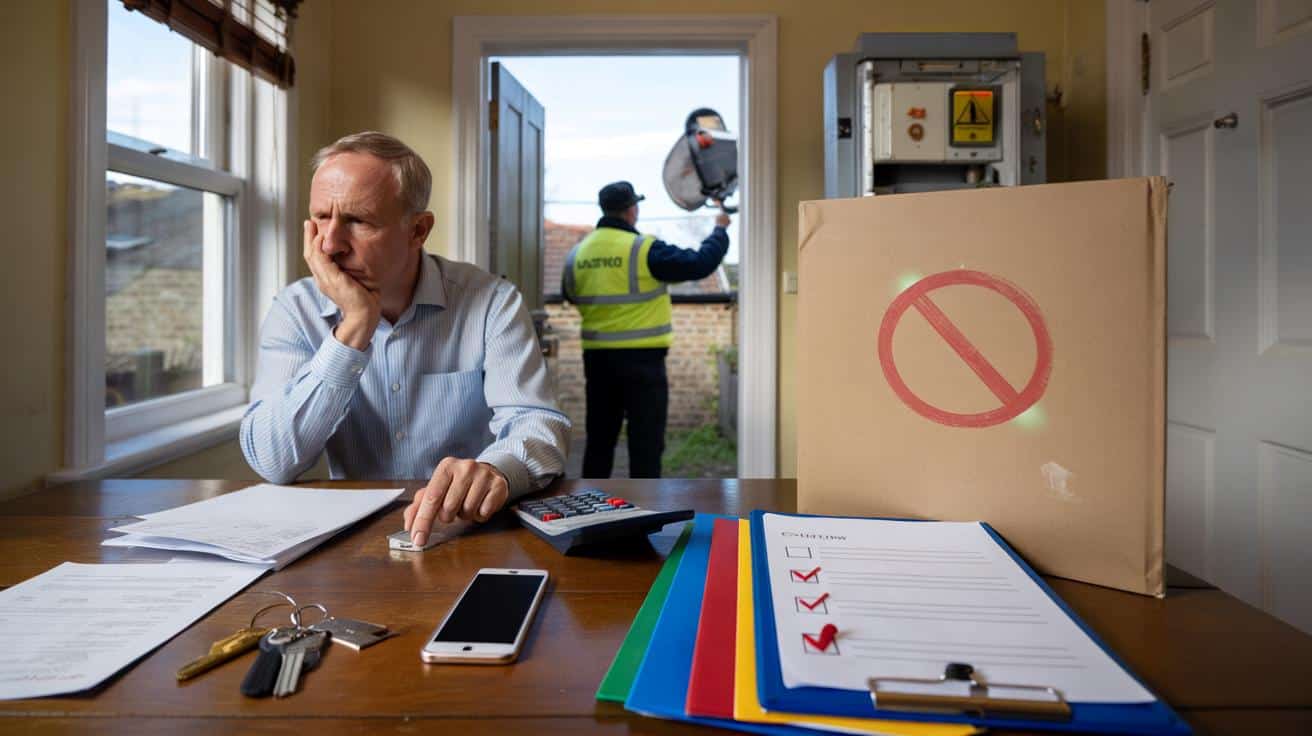
Landlords in England are waking up to a tougher truth: under new government guidance, councils are gearing up to issue bigger, faster civil penalties for common renting breaches. The sums being talked about on enforcement desks run from **£3,000** for lower-level failings to as much as **£35,000** when multiple offences stack. This isn’t theory any more. It’s how the next knock on the door might sound.
“Updated enforcement approach,” it reads. He mutters the figures under his breath, the way someone reads a restaurant bill after a long night. His agent hovers, half apologetic, half braced for the blame. Phones trill. A printer coughs out yet another compliance checklist.
Outside, school-run traffic squeezes past delivery vans. Inside, every acronym suddenly feels heavier: HMO, HHSRS, MEES, RTW. The landlord taps a calculator, then stops and stares. *It felt like watching the lines on a till receipt creep up, one item at a time.*
The small print bites.
What’s changing behind those fines
The government has refreshed guidance to local authorities on using civil penalties for housing offences, and councils are taking the hint. More teams are moving away from warnings and straight to fines, using banded frameworks that tie the amount to harm, culpability and history. The lower end often lands at around **£3,000** for a first, limited-impact offence. The upper end climbs sharply when there’s risk to safety, repeat behaviour, or clear financial gain.
On a busy Tuesday, one enforcement officer put it bluntly to me: they’re told to make penalties “sting, not tickle.” That means damp-and-mould negligence, missing or expired HMO licences, unsafe electrics, and unlawful fees are prime targets. The messaging across council websites has shifted too. Less patience for “accidental” oversights. More emphasis on evidence, time-stamped records, and early intervention.
In practice, that’s why you’re seeing £3,000 for smoke and carbon monoxide alarm breaches, £5,000 bands for unlawful fees, and £10,000–£30,000 brackets for licensing and serious safety offences. When two or three failings are found in the same inspection, totals can push towards **£35,000**. Add Right to Rent breaches into the conversation and the risk picture gets even starker.
How this lands in real life
Take Mr Singh in Leicester, a part-time landlord with a pair of terraced HMOs near the ring road. He missed a licence renewal while caring for his mum, then a tenant flagged a broken heat alarm that had been out for weeks. The visit snowballed: the council found paperwork gaps, a faulty emergency light, and a bedroom over the permitted occupancy. By the time a Notice of Intent arrived, the proposed civil penalty schedule had five lines on it.
His first call was not to a lawyer, but to his brother. They went room by room overnight, fixing what they could and documenting everything else. It helped. The final penalties were lower than the draft, but still a jolt. One line item that stuck with him: £3,000 for life safety alarms. Another for licensing. The point is simple. Once the machine turns, it can run through every corner of a tenancy.
Why the sharp edges? Councils argue deterrence and cost recovery. Investigations take time. So they use a matrix: harm (actual or potential), culpability (was it reckless, negligent, or a genuine error), and history. A clean record matters, though not as much as some think. Published schedules vary by borough, yet the shape is similar. A single offence rarely hits the ceiling, but a cluster will. That’s how a “small” oversight can morph into a five-figure decision in a week.
A practical path to stay out of trouble
Build a 90-day rhythm. One hour, four times a year. Call it your landlord MOT. Start with life safety: test and log smoke and CO alarms, note battery swaps, photograph the test button lit up. Review licensing: is this property licensable today, not just last year? Check deposit dates and prescribed information in one sitting. Download the latest How to Rent guide and save a PDF with the date sent. Confirm your EPC rating and, if you’re at F or G, map the cheapest uplift to E. For Right to Rent, use an approved digital check or in-person verification and save the report.
Common tripwires sound boring because they are. Forgetting to renew a licence as soon as a bedroom is reconfigured. Sending the How to Rent guide to a tenant but not the version in force on the day. Deposit protection done at day 31. Not malicious, just messy. We’ve all had that moment when a login won’t work and you swear you’ll sort it next week. Let’s be honest: nobody does this every day.
Think like an inspector: would a stranger be able to see what you did and when you did it? Keep a short, plain-English compliance folder for each property with four tabs: Safety, Licensing, Tenancy, Money. Print the front sheet with dates and signatures. When you address a risk, note it in past tense and add a photo. Transparency calms nerves in an inspection.
“The landlords who sleep best aren’t the ones who never get things wrong,” a housing officer in Bristol told me. “They’re the ones who show their workings.”
- Tonight: test alarms, take photos, and email yourself the images with the property address as the subject.
- This week: download and file the current How to Rent guide; cross-check your local licensing page for changes.
- This month: run a basic electrical check list and book an EICR date if you’re within six months of expiry.
- This quarter: review deposits, service gas boiler if due, and audit fees for Tenant Fees Act compliance.
- When tenants change: refresh Right to Rent checks using the most recent method and save the report.
What this tells us about renting now
Enforcement is moving faster than the culture. For years, the private rented sector ran on informal fixes and gentleman’s agreements. The new guidance signals something different: formal rules, visible evidence, and penalties that travel with you if you ignore both. That doesn’t make every landlord a villain, nor every council a hero. It does mean the space between a tidy spreadsheet and a nasty letter has narrowed. Share this with the person in your life who keeps the keys and the calendar. There’s relief in a small routine. There’s also a fairness, because good practice stops being invisible when the sums get public. The market is watching, and tenants talk.
| Key Point | Detail | Interest for the reader |
|---|---|---|
| New enforcement tone | Guidance pushes councils to use civil penalties quickly, with banded amounts tied to harm and culpability. | Understand why warnings are rarer and fines land sooner. |
| Fine range in reality | Single breaches can start near £3,000; combined offences and repeat behaviour can climb towards £35,000. | Gauge real financial exposure, not just theoretical maximums. |
| 90-day landlord MOT | One hour per quarter to test alarms, check licensing, file documents, and update Right to Rent and EPC steps. | Practical, repeatable routine that lowers risk and stress. |
FAQ :
- Are these penalties criminal fines or civil penalties?Mostly civil penalties under housing legislation, issued by councils without going to court. Serious cases can still lead to prosecution, where fines can be higher and criminal records apply.
- Can I appeal a civil penalty?Yes. You can make written representations to the council, and if they proceed, you can appeal to the First-tier Tribunal. Evidence, timelines, and proof of remedial action matter.
- Does this hit “accidental” landlords the same as big operators?The matrix focuses on harm and culpability. Scale doesn’t grant a discount. A tidy paper trail and quick fixes will help any landlord, large or small.
- What offences are most likely to trigger a fine now?Missing or expired HMO licences, unsafe or missing alarms, serious damp and mould, unlawful fees, poor electrical or gas safety, and weak Right to Rent checks.
- Do these figures apply across the UK?The approach here reflects England. Scotland and Wales have different regimes and terminology, with their own penalties. Always check your local authority’s published policy.








Helpful breakdown, but how exactly do councils score harm vs culpability? If I fix issues within 48 hours and document, does that typically drop a band? Any real-world tribunal outcomes on smoke/CO alarm breaches around £3,000? Trying to gauge whether prompt remediation and a clean record actually moves the needle or if it’s mostly baked in.