
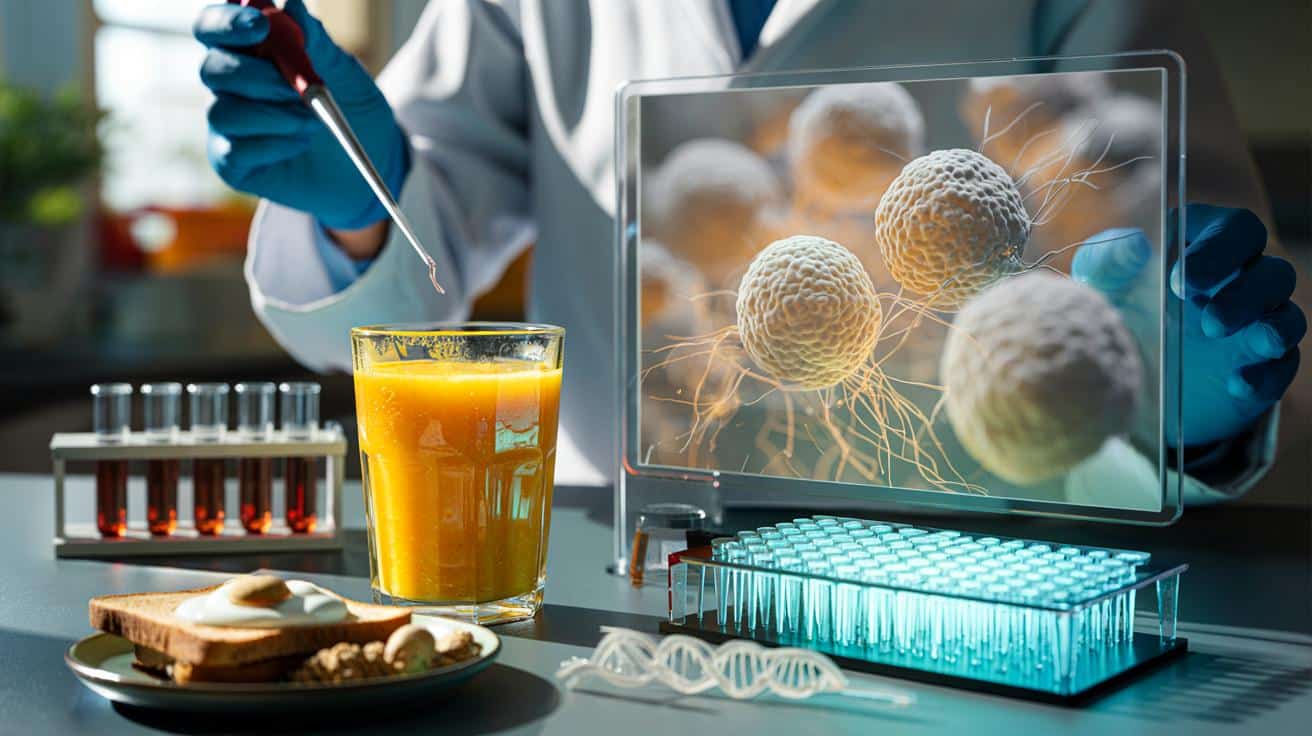
Not in every cell, not permanently, but in those watchful sentinels patrolling our blood — the **immune cells** that decide whether to stand down or sound the alarm. It raises a simple question with big ripples: what is your morning glass actually doing to you?
The kettle hissed, the radio mumbled sports headlines, and the light through the kitchen window stained the counter tangerine. You pour a glass of orange juice without thinking, a reflex carried from childhood. Across town, lab techs did the same pour, only they followed it with needles, vials and a genomic scanner. Volunteers rolled up their sleeves. Blood was drawn before and after they sipped. Hours, then weeks. On a screen, lines of code blinked as genes in immune cells turned a little up here, a little down there, like a dimmer switch on a restless room. Breakfast talks to your genes.
Inside the study: breakfast meets biology
The team looked at peripheral blood mononuclear cells, the workhorse **immune cells** that float through our veins. They used RNA sequencing to measure which genes were being read more or less after people drank 100% orange juice. Thousands of genes moved. Not all at once, not all by much, but enough to map out pathways linked to stress responses, antiviral signalling and inflammation. Think of it as shifting a city’s traffic lights: same streets, different flow.
One participant told me he felt nothing beyond the usual bright citrus lift. The lab felt plenty. Within a few hours of a standard glass, activity nudged in interferon pathways — the body’s early warning system for viruses — while markers tied to oxidative stress edged the other way. After several weeks of daily juice, a different pattern emerged, steadier and broader. You don’t sense gene expression the way you sense caffeine, yet the data shows a quiet choreography, sustained by a breakfast habit.
What could be driving it? Citrus carries a small orchestra: vitamin C, folate, carotenoids and polyphenols such as **hesperidin** and naringenin. Once digested, their metabolites mingle with cell receptors and transcription factors — Nrf2 for antioxidant defences, NF-κB for inflammatory traffic, interferon signalling for antiviral posture. Sugar is there too, and context matters. A glass with food lands differently to a glass rushed on an empty stomach. These are nudges, not rewrites. Small study sizes limit certainty, but the pattern — modest shifts across many genes — fits the idea of food as a daily dial.
How to put this to work without overthinking breakfast
Start with the glass, not the jug. A 150–200 ml pour hits a sweet spot for most adults, especially when paired with protein or fibre at breakfast. Wholegrain toast, a dollop of yoghurt, a handful of nuts. Choose 100% orange juice over “juice drinks” with added sugar. If your teeth are sensitive, drink it with a meal and rinse with water afterwards. Chilling it isn’t just a vibe; cooler juice tends to be sipped slower, which is kinder to blood sugar and to that quiet genetic whisper.
Common slip-ups are surprisingly ordinary. The “pint glass problem” — pouring far more than you think. The “health halo” — assuming anything orange and cold is the same as 100% juice. The “sugar blind spot” — ignoring how the rest of your day stacks up. We’ve all had that moment when a virtue choice at breakfast unravels by mid-afternoon. Go easy on the guilt. Let’s be honest: no one really does that every day. Small, repeatable habits beat grand promises.
Scientists will tell you these results don’t mean orange juice is a cure-all. They do suggest your breakfast can modulate biological readiness in a measurable way.
“Food doesn’t act like a drug with one target,” one researcher told me. “It nudges networks, and those networks include immunity.”
- Pick 100% orange juice, 150–200 ml, with a meal.
- Pair with protein or fibre to smooth the sugar curve.
- Alternate with whole oranges for extra fibre.
- Think week-by-week, not day-by-day; consistency beats spikes.
- If you manage glucose or weight, talk to a clinician about what fits.
The bigger picture: your breakfast as a biochemical nudge
This is where the story gets more human. Gene expression is dynamic. It rises and falls with sleep, stress, movement, light, and yes, what’s in your glass. Orange juice won’t make you invincible, yet these signals suggest diet can tune the readiness of the immune orchestra in real time. *Science rarely fits neatly into a breakfast glass.* Still, it’s striking to see the invisible rendered in data: a cheap, familiar food whispering to pathways we usually only discuss in clinics and lecture halls.
What happens next is the interesting bit. Expect more studies with larger groups, more diverse diets, and personalisation based on microbiome and genetics. Some people metabolise citrus flavanones swiftly, others slowly; the magnitude of the gene response may differ. The takeaway today is a nudge, not a prescription: enjoy the glass you like, at a size that fits your life, alongside a pattern of eating that treats your body kindly. Then share the finding with a friend and ask the question we’ll be asking for years: what else is our food saying to us?
| Key Point | Detail | Interest for the reader |
|---|---|---|
| Orange juice modulates gene activity | RNA sequencing shows shifts across thousands of genes in immune cells after drinking 100% OJ | Makes the everyday glass feel newly powerful — and measurable |
| Pathways involved | Changes touch interferon signalling, oxidative stress, and inflammatory traffic | Links a familiar food to how the body prepares for threats |
| Practical use | 150–200 ml with food, focus on 100% juice, pair with protein or fibre | Actionable steps without overhauling breakfast |
FAQ :
- Does orange juice really change genes?It changes gene expression — which genes are turned up or down — in circulating immune cells. It doesn’t alter your DNA sequence.
- How much should I drink?For most adults, 150–200 ml of 100% orange juice with a meal is a sensible place to start. Think of it as one fruit serving.
- What about the sugar?Juice contains natural sugars. Pairing it with protein or fibre slows absorption. If you monitor glucose or calories, factor it into your daily total.
- Is whole fruit better than juice?Whole oranges bring fibre and fullness. Juice delivers the same vitamins and flavanones in a smaller volume, minus the fibre. Alternating both works well.
- Will it stop me getting sick?No drink can guarantee that. The study points to immune-related pathways being nudged. Real-world protection still depends on sleep, diet, vaccines and exposure.





Mind = blown that breakfast can nudge interferon pathways. Is 150–200 ml really enough, or just a safe guess? I always thought sugar would cancel benefits. Thanks for clarifying it’s gene expresion, not DNA changes—definitley helpful.
Cool narrative, but what were the sample size and controls? Could sleep, caffeine, or time-of-day be confounders? Please share pre-registered protocol, raw counts, effect sizes, and pathway FDRs; otherwise it reads like overfitting.