
Scientists now think those same dogs may be changing faster than expected. The question is what that really means.
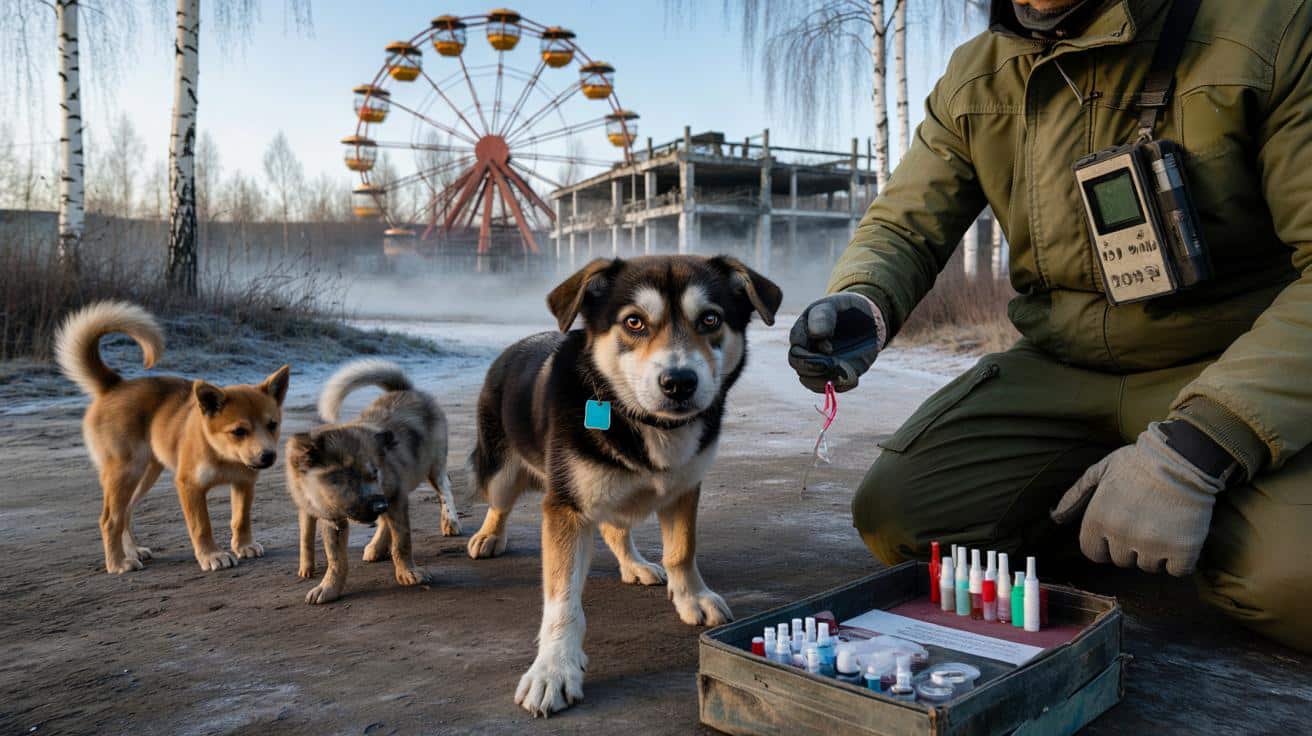
The morning light over Pripyat is thin and glassy, the kind that makes rust look like lace. A handler clicks his tongue, and half a dozen dogs spill from behind a tangle of birch and fencing, tails up, ears pricked, hungry but wary. A Geiger counter on his flak jacket chirps like a metronome someone set too fast. One dog wears a turquoise tag; another carries a limp left paw but moves with the swagger of a street survivor. Wind moves through the ferris wheel, slow and indifferent. The dogs eat, then drift, cartoon-silent across a landscape that once howled. You can feel the past pressing under your feet like a sprung floorboard. Something else is at work.
What the new study really shows
Researchers working with animal welfare teams have been sampling the Chernobyl dog population for years. Blood draws, cheek swabs, location data, radiation readings at the moment of capture. Not a handful of pets, a structured sweep across distinct hot and cooler zones. The headline claim is simple to phrase and complex to prove: genetic changes appear to be accumulating and spreading through these dogs at a clip suggesting accelerated evolution.
Think of one tagged female, found near the rail spur by the plant, then resighted the next year with two pups. Her DNA sits not just in a freezer but in a dataset alongside hundreds of others, traced to neighbourhoods around the reactor, the cooling pond, the workers’ canteens. Across the map, the dogs form genetic clusters that line up with geography and dose history. It’s not a Marvel plot. It’s a pattern: variants linked to stress responses, DNA repair and metabolism showing up more often where radiation has been consistently higher.
Evolution is not a miracle; it’s a ledger. Mutations arise in every population. Environments shuffle the deck, rewarding some variants and quietly dropping others. In the Exclusion Zone, the shuffle is fiercer. Short dog generations, hard winters, a viral roulette of disease, a radioactive background that nudges the odds. Across thirty-plus years, that can mean ten or fifteen generations. Multiply selective nudges by time, and the numbers stop feeling small.
How to read “accelerated evolution” like a pro
Start with the controls. Ask: did the team compare Chernobyl dogs with nearby dogs living outside the Zone? Then look for gradients. Do genetic shifts track with dose levels, not just distance from the reactor? Finally, check the biology under the hood. Claims are stronger when changes turn up in pathways that make sense here: oxidative stress, immune function, DNA repair. If those boxes tick, the phrase “accelerated evolution” moves from headline gloss to a working hypothesis.
Watch for traps that trip up even careful readers. Evolution doesn’t equal mutation, and mutation doesn’t always equal adaptation. We’re not looking for glowing eyes or sci‑fi resistance to everything. We’re looking for tiny, boring shifts that stack into survival advantages over time. We’ve all had that moment when a headline promises a breakthrough and our gut throws confetti. Then the paper lands with sobering caveats. Let curiosity lead, but keep your boots on.
Let’s be honest: nobody does that every day.
“Radiation raises the stakes; evolution does the sorting,” a field geneticist told me. “The surprise isn’t that change is happening. It’s how fast populations can reorganise when the pressure stays on.”
- Check for sample size and site diversity across the Zone.
- Look for dose maps tied to capture locations, not just averages.
- Scan which gene pathways show signals; ask if they fit the ecology.
- Read the limitations section like a hawk: drift, inbreeding, and human feeding matter.
What this means for dogs, and for us
These animals have become a mirror rather than a myth. Their story is not about superpowers. It’s about life finding room to move inside bad luck. **No one is claiming invincibility.** What scientists are circling is a momentum: repeated, directional genetic shifts in a population pinned beneath a steady environmental pressure. **The take-home is less “mutant dogs” and more “fast feedback loop” between landscape and genome.** People will argue the semantics of “accelerated”. Fair. The deeper point is that years, not millennia, can be enough for evolution to leave fingerprints you can measure.
On the ground, the details matter
Walk any of the checkpoint roads and you notice small things first. Coats thicker than city strays. Body sizes skewed a touch smaller at high‑dose sites. Packs centred on food handouts by maintenance crews, then fanning out into the pines. Welfare teams vaccinate, neuter, and tag where they can; researchers piggyback on that work to build a map of dog life here. **These dogs have become a living experiment in survival.** The method is humble: needle, swab, note, release.
Common misreads are easy to forgive. People see “accelerated” and think “good.” Sometimes it’s a tax, not a prize. Some pups don’t make it through their first winter. Some lines wink out. An uptick in DNA repair variants could mean fewer cancers, or it could just mean the ones without those variants don’t leave as many descendants. The Zone is a teacher with a hard grading curve. Nobody gets through without scars.
Scientists speak a different dialect than headlines, and it shows.
“What we see are signals, not certainties,” said one co-author. “We’re tracking probabilities nudged by place.”
- Accelerated evolution here means quicker shifts in gene frequencies, not overnight new species.
- Radiation is one pressure among many: hunger, cold, parasites and humans all push.
- Gene flow from outside villages can blur or slow the signal.
- Replication will come as more years, more dogs, and better dose histories stack up.
The bigger picture you can carry away
Leave the Zone and the world looks cleaner, then complicated again. Cities have their own invisible pressures: traffic, heat, chemicals, our moods. The Chernobyl dogs are not a sideshow. They’re a reminder that evolution doesn’t wait for an exam bell. It ticks along in alleles and litters and the way a pack chooses a den. Share the photos and the awe, but keep a little space for what’s harder to Instagram: the slow mathematics of survival. Headlines will move on. These dogs will keep living their days between birch and concrete, ears full of wind and distant humming, writing a story in their blood that nobody asked them to write.
| Key Point | Detail | Interest for the reader |
|---|---|---|
| What “accelerated evolution” means | Faster shifts in gene frequencies under sustained pressure, measured across dozens of dog generations | Demystifies the claim and cuts through the sci‑fi noise |
| How scientists tested it | Hundreds of dogs sampled across radiation gradients, compared with outside populations and mapped to known pathways | Shows the nuts and bolts behind a viral headline |
| Why it matters | Offers a living case study of adaptation under chronic stress with lessons for health, ecology and risk | Connects a distant place to everyday life and choices |
FAQ :
- Are the Chernobyl dogs really evolving faster?Researchers see genetic changes stacking up more quickly than you’d expect in a calmer environment. That suggests a speed‑up, yet it’s still a hypothesis that needs more years of data.
- What traits might be changing?Signals point to pathways tied to DNA repair, oxidative stress and immune function. You won’t spot them at a glance; they’re inside the genome, not neon on the fur.
- Is radiation helping these dogs?Radiation is a stressor, not a gift. Any apparent advantages are the survivors’ advantages, not superpowers. Many animals pay the price along the way.
- How did scientists study them?By teaming with welfare groups to sample dogs across different sites, logging local dose levels, and comparing their DNA with reference dogs from outside the Zone.
- Can people adopt or support these dogs?Some groups run vaccination, feeding and neutering programmes, and a few facilitate adoption under strict rules. The safer route for most is donating to vetted charities working on the ground.








Fascinating read. When you say the dogs form genetic clusters that track with dose history, did the team compare them to control populations outside the Zone and account for gene flow? Also, how large are the effects in pathways like DNA repair—tiny nudges or big shifts? I’d love a link to the dataset/methods; otherwise I’m guessing at teh stats.