
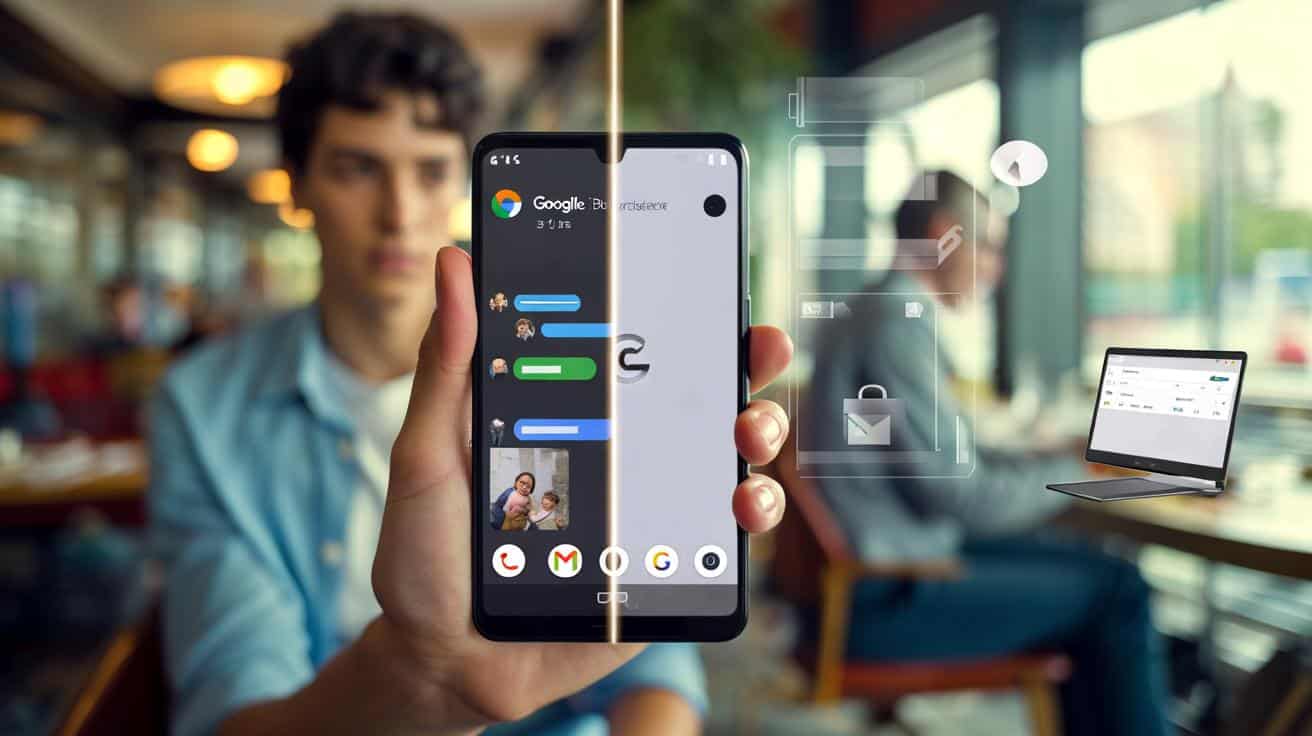
A viral headline says Google begins sharing all your text messages with your employer. The thought lands like a cold coin in your stomach. What’s real, what’s rumour, and what lives in the murky space where work policy meets the messages you send at 11:42 p.m.?
The coffee line was loud, but the whispers were louder. A designer in a varsity jacket leaned in, swiping through a company notice on her Pixel: “policy changes,” “data visibility,” the words we all pretend don’t concern us. She joked that HR could now read her memes. Everyone laughed, then stared at their screens with that quiet twitch we get when a notification lands, mid-laugh, and cuts the air in two.
Slack pinged. A text from Mum arrived. The group chat about Saturday fizzed like a fuse. I could feel two lives on one glass pane, each asking for a different version of me. *I did what everyone does: I Googled it under the desk.* A post said bosses could see everything. A friend swore his old company monitored SMS. “It’s live,” he said. Someone was already reading.
What’s actually changing — and what isn’t
Let’s start with the line that travels fastest: **No, Google is not sending your personal SMS to your boss.** What is happening sits in the less-glamorous realm of enterprise device management. If your phone is company-owned or enrolled in management, your employer can set rules, keep audit logs, and retain messages sent through company services. That includes tools like Google Chat in a corporate Workspace account, not the carrier SMS threads you send to your flatmate about milk.
The grey zone appears on company-managed Android devices, especially when work and personal live side by side. Picture Zoe in marketing. She carries a company-issued Pixel with a Work Profile. IT can push apps, check compliance, and wipe the work side remotely if she leaves. On some corporate setups, SMS tied to the work line or business number may be logged by the company’s management tool. Her personal chats, in the Personal Profile, remain on her side of the fence. It’s the fence that matters.
Android offers different modes with different trade-offs. BYOD with a Work Profile lets you keep personal apps and data separate from employer control. COPE and COBO setups tilt more power to IT on company-provided devices. Google Messages can use RCS with end-to-end encryption for person-to-person chats, which limits visibility in transit, while old-school SMS is just plain text over the carrier. Google Workspace admins can retain email and Google Chat in Vault for corporate accounts. None of that means a blanket tap of your private texts.
How your messages might be exposed at work
Start with the simplest check: is your phone managed? On Android, open Settings and look for Accounts, then Work profile or Device management. If you see a briefcase icon on apps, that’s your managed Work Profile. In Settings, search for “Device Policy” or your company’s management app. Open Google Messages and tap your avatar, then Message settings, and review which account handles chat features. If your number belongs to the company, treat SMS sent on that line as company territory.
Next, draw clean lines. Use your Work Profile for anything your employer provides: email, chat, calendar, video. Keep family and personal chats in your Personal Profile. Pick one channel per relationship and stick to it. People trip when they mix work chats into personal SMS threads at night or reply from a corporate number on instinct. We’ve all had that moment when the wrong bubble goes to the wrong person. Let’s be honest: nobody reads those privacy notices end to end.
There’s also the messy middle, where policies change and people hear about it via rumour. A privacy lawyer I spoke to put it in plain English:
“Company tools are company records. Personal tools on your personal side are not — unless you drag them into the company’s system or device.”
- Check who owns the phone number tied to your SIM. Corporate number, corporate rules.
- Keep Work Profile notifications separate, and mute after hours if your policy allows.
- Avoid forwarding work messages to personal apps, or vice versa.
- If you leave, export personal data from the Personal Profile before IT wipes the work side.
- When in doubt, ask HR or IT for a written summary of what they can actually see.
The fine print that decides your privacy
The big lever is ownership. If your employer owns the device, they can set broader controls. Company-owned, company-only (COBO) setups often include deeper logging, sometimes including SMS metadata on that device. Company-owned, personally enabled (COPE) splits the phone into work and personal profiles but still gives IT more levers than pure BYOD. BYOD with Work Profile is the closest thing to a clean boundary: personal space, employer space, a wall in between.
The next lever is the app and account you use. Corporate Google Chat messages, calendar invites, and email in a Workspace account can be archived under the company’s retention rules. Google Messages using RCS between personal accounts gains encryption end to end. Traditional SMS has no such protection in transit, and on a corporate number it can be treated as a business record. The same message in two different places lives under two different laws.
Then there’s policy. Some companies keep short retention windows; others hold records for years. Some record only security events; others log device compliance, app installs, even attempts to disable the Work Profile. The headlines miss the mundane middle: policy documents, admin toggles, liability fears. **Company-owned vs BYOD matters.** So does your choice of chat bubble. That’s where your privacy is decided, line by line.
Practical moves that protect your everyday
Make a map of your digital house. On Android, long-press the briefcase icon on any app to switch profiles. Keep Google Messages in Personal Profile for family and friends, and use Google Chat or your corporate messenger only inside Work Profile. In Messages, turn on chat features for RCS with personal contacts where available, then leave SMS for two-factor codes and delivery pings. If your employer gave you a number, store it in your contacts as “Work Mobile” to reduce autopilot mistakes.
Untangle your notifications. Use different sounds or vibrations for work vs personal. Put the Work Profile on a separate home screen panel, then hide that page outside office hours. Review your lock screen previews so snippets don’t flash during meetings. People often forget cloud backups: check if your SMS are backing up to a personal Google account, not a work one, and avoid cross-signing into corporate apps on the personal side. **Work Profile is your friend.** It exists to protect you as much as your employer.
When you hit a grey area, ask three questions: Who owns the device? Which account sends the message? Where will that message be stored? If all three point to “work,” treat it like a record. If two are personal, you’re likely on safe ground. One security lead told me:
“We don’t want your private life. We want to manage risk on the part of the phone we pay for.”
- Use one channel per relationship, and label it clearly.
- Keep sensitive chats off SMS on corporate numbers.
- If you use dual SIM, dedicate one line to work, one to life.
- Ask IT for a one-page summary of monitoring in plain language.
- Before travel, recheck roaming rules for managed devices.
What this all means for your next text
The rumour makes a neat villain. Real life is messier, and arguably trickier. Your employer isn’t diving into your personal messages by default. They are tidying the work lane on a road you both share. That lane can widen on company-issued phones, and shrink on BYOD with a well-kept Work Profile. The choice of app, number, and account becomes the new streetlight.
So the next time a headline screams that managers can read everything, pause. Ask those three questions. Open Settings and look for the briefcase. Decide where a conversation should live before the first word is sent. The best privacy move is often the smallest one: a different icon, a second number, a habit you repeat without thinking. The world won’t get less digital. You can still keep your life yours.
| Key Point | Detail | Interest for the reader |
|---|---|---|
| Ownership sets the rules | Company-owned devices allow broader admin controls than BYOD with Work Profile | Know at a glance how much visibility your employer can claim |
| App and account matter | Corporate Workspace data can be retained; personal RCS is encrypted; SMS is plain text | Pick the right bubble for the right conversation |
| Simple habits prevent leaks | Separate profiles, distinct notifications, one channel per relationship | Practical steps you can apply today without new tools |
FAQ :
- Is Google sharing all my text messages with my employer?No. Employers may retain messages in company apps and manage data on company-owned or managed devices, but your personal SMS on your personal side are not being auto-shared.
- Can my company read Google Messages or RCS chats?Person-to-person RCS is end-to-end encrypted on personal accounts. SMS isn’t encrypted in transit, and on a corporate number it can be treated as a business record.
- What if I use a personal phone with a Work Profile?Your Work Profile is managed; your Personal Profile is not. Admins can control the work side and its apps, not your personal messages and photos.
- Can my employer get old messages from backups or carriers?They can retain data in corporate accounts and systems. Personal cloud backups under your own account are not company records. Carrier access depends on legal process, not a company setting.
- How do I keep work and life separate on Android?Use the Work Profile for all corporate apps, keep personal chats in the Personal Profile, set distinct notifications, and avoid mixing channels across profiles.






Phew—so my personal SMS aren’t being sent to my boss after all.
This should have led with “No, your personal SMS aren’t being sent.” I almost had a heart atack. Clearer up top would save panic.